
The science behind hill repeats?
Chicago isn't known for its hills, yet we spend hours running up and down them. Turns out there's real science behind the physical benefits, and some interesting psychology behind why we keep doing it.
Physics
Gravity Is Doing Its Job.
Running on flat ground is mostly a matter of moving forward. Running uphill adds a second job: raising your body mass against gravity. That part of the work can be calculated directly. Lifting a mass through a height takes at least mass × gravitational acceleration × height in mechanical work.
W = m · g · h
Here m is body mass, g is about 9.81 meters per second squared, and h is the height gained. For a 70 kg runner climbing 40 feet (about 12.2 meters), that comes to roughly 8.4 kilojoules per climb.
That number is a minimum. Muscles convert chemical energy into mechanical work far less than perfectly, and the body pays for the whole conversion, so the metabolic cost of the same climb is several times larger.
Grade, angle and gain are different things
Grade is rise divided by horizontal distance, written as a percentage. A path that rises 10 feet over 100 feet of horizontal distance has a 10 percent grade. The incline angle describes the same slope in degrees: 10 percent is about 5.7 degrees. A 100 percent grade is a 45 degree slope, not a vertical wall.
Elevation gain is simply how far up you went, however steep the route. Physiological effort is something else again. It depends on how fast you climb, how steep the slope is, the surface, your fitness, and how much of the climb you run or walk. Two runners can record the same gain and have very different workouts.
Adjust the controls in the figure belowfigure to the right to explore the relationship between grade, angle, and elevation gain.
Figure 1 · Incline geometry
- Grade
- 0%
- Angle
- 0.0°
- Rise
- 0.0 ft
Geometry only. The drawing and numbers show how grade, angle and rise relate on a uniform slope, drawn to scale. They do not estimate effort, oxygen use or calories.
The cost of going up
Gravity accounts for only part of what running uphill costs. The legs still support the body, swing forward, and absorb and return energy with every step. In a classic treadmill study, Minetti and colleagues measured the energy cost of running on slopes from −45 to +45 percent 1. On the level, running cost about 3.4 joules per kilogram of body mass per meter traveled, largely independent of speed. At +45 percent it was about 18.9, more than five times as much.
Downhill, the cost fell to a minimum of about 1.7 at −20 percent, then rose again on steeper descents. At steep uphill gradients the efficiency of running approached that of muscle shortening under load, and at steep downhill gradients that of muscle lengthening under load 1.
More recent reviews confirm the broad pattern and add detail. On a slope, metabolic cost also changes with speed, footwear, cadence, foot strike and the runner's experience on graded terrain 2.
Why a small hill is enough
None of this requires a mountain. A hill that rises 40 feet is short, but the work of climbing it is the same every time, and repetition turns a short climb into a meaningful total. Twenty-five climbs add up to 1,000 feet of gain.
A short hill limits how long each climb lasts. It doesn't limit how much climbing you can do.
Figure 2 · Energy cost of running by gradient
| Gradient | −45% | −20% | 0% | +45% |
|---|---|---|---|---|
| J per kg per m | 3.9 | 1.7 | 3.4 | 18.9 |
Physiology
Your Legs Have Complaints.
Uphill running is not flat running tilted a few degrees. The slope changes how the body moves, which muscles do the most work, and how hard the heart and lungs work to keep up.
Shorter steps, more push
At a given speed on an incline, runners tend to take shorter, quicker steps and spend less time in the air 2. Ground contact changes too. In an instrumented-treadmill study, the propulsive part of each footstrike roughly doubled on the steepest uphill grade tested at the fastest speed, while the braking part almost disappeared and the rate of impact loading fell 3.
More of each step goes into pushing up and forward, and less into absorbing a landing.
Who does the work
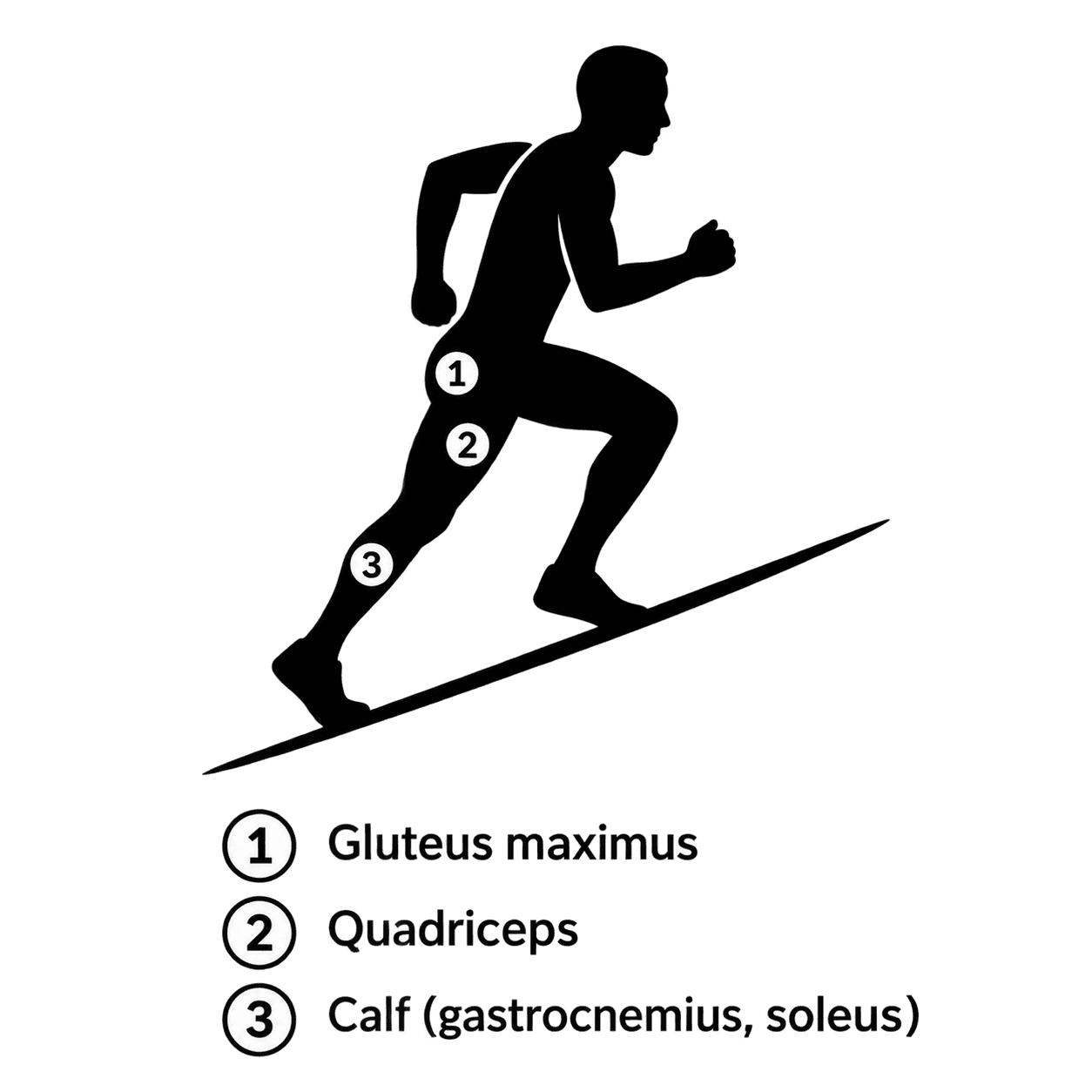
The muscles that drive the body forward on the flat drive it upward on a hill, and they work harder doing it. Studies of muscle activity during uphill running report greater activity in the main propulsive muscles of the leg 2. Other muscles, including those of the trunk, help hold posture as the body leans into the slope.
- Hip extensorsGluteus maximus, with the hamstrings
- Extend the hip, driving the body up and forward. The hip supplies a larger share of the work on steeper grades at faster speeds. 4
- Knee extensorsQuadriceps
- Straighten the knee against body weight during stance.
- Ankle plantar flexorsGastrocnemius and soleus (the calf)
- Push the foot against the slope toward the end of stance.
Heart and lungs
Because each step on an incline does more work, oxygen demand rises with gradient at a given speed, and heart rate, breathing and oxygen uptake rise to meet it 2. A pace that feels easy on the lakefront path can feel hard on a modest hill. That's why uphill intensity is usually judged by effort or heart rate rather than pace.
Activation is not adaptation
It's tempting to read “more muscle activity” as “more strength.” They are not the same. Muscle activation describes what happens during a run. Adaptations develop over weeks of training: changes in strength, in how the nervous system coordinates muscles, and in running economy, the oxygen cost of running at a given speed. Whether they develop depends on the dose, the runner and what else they are doing.
The training studies, covered in the next section, show that the link between uphill running and those adaptations is less certain than the activation data suggest 5.
Figure 3 · Uphill push-off
Training
Small Hill. Real Work.
A single climb on a short hill may last well under a minute. The training stimulus comes from the whole session: how many times you climb, how hard, how long each effort lasts, and how much recovery you take between them.
Adding it up
Repetition accumulates two things. One is vertical gain, which is simple arithmetic. The other is time spent working against gravity, which matters more for training but is harder to count. The accumulator handles the arithmetic.
Enter the gain of one climb and the number of repeats in the figure belowfigure to the right to see the total.
Figure 4 · Elevation accumulator
Total accumulated gain
About 305 m
One hill, different workouts
The same hill can serve very different purposes depending on how you run it.
- Short, hard repeats
- Brief efforts near the top of your range, with full recovery between them. The emphasis is on power, uphill mechanics and high-intensity work. Each effort is short, so quality can stay high.
- Sustained climbing
- Steady, repeated climbs at an effort you could hold for a long time, with easy descents. The emphasis is aerobic: accumulating time and elevation at a manageable intensity.
Between those two sit many variations. Change the effort, the length of each climb, the recovery or the number of repeats, and the workout changes with it.
What the research does and doesn't show
Hill repeats are a long-standing part of distance training, and there are good reasons to include them. The controlled research, though, is thinner and more mixed than their reputation suggests.
In one carefully designed study, 20 well-trained runners completed six weeks of different uphill interval programs 6. On average their 5 km time-trial performance improved by about 2 percent, with no clear best program, and the highest-intensity program produced the largest gain in running economy. Every group trained on hills, so the study shows what different hill programs did, not whether hills beat the same effort on flat ground.
A 2026 systematic review and meta-analysis gathered 13 randomized controlled trials of uphill running in athletes and recreationally active adults 5. Individual trials reported improvements in running economy, repeated-sprint ability and some aerobic markers. Where the data could be pooled, though, uphill running showed no significant effect on knee strength, jumping performance or aerobic capacity compared with other training, and the authors rated the certainty of the evidence as low: the trials were few and small, and their protocols varied.
A fair reading: hill training is a reasonable and specific way to get better at climbing, and it may help other qualities. It is not a reliable shortcut to a higher VO₂max, more strength or faster racing. Like most training, what it does depends on how it's done and what it replaces.
Breathing
Breathing. It's Kind of Important.
You've been breathing your entire life. Congratulations. You're probably pretty good at it.
But there's a difference between breathing automatically and breathing intentionally.
Whether you're climbing a mountain at altitude, grinding through your twentieth hill repeat, or trying to convince yourself that another five miles sounds reasonable, the way you breathe can influence how you experience physical effort and stress.
The interesting part is that breathing is both automatic and something you can consciously control. That gives us a direct way to influence certain physiological and psychological responses.
The mechanics of breathing
At rest, breathing is mostly the diaphragm's job. The dome-shaped muscle beneath the lungs contracts and flattens, the chest expands, and air flows in. Breathing out at rest is largely passive: the lungs and chest wall spring back.
Exercise changes the arrangement. Working muscles use more oxygen and produce more carbon dioxide, and ventilation, the volume of air moved each minute, rises to match. Breaths get deeper and faster. Muscles between the ribs and in the neck help lift the ribcage, and the abdominal muscles start pushing air out instead of waiting for the lungs to recoil 7.
In healthy people exercising near sea level, that system is precisely regulated to keep oxygen and carbon dioxide in the blood close to their usual levels 7. What changes most noticeably is how it feels. Faster, harder breathing is a large part of what makes hard running feel hard.
Controlled breathing and mindfulness
Several techniques put that conscious control to use, each in a different way:
- Box breathing
- Equal counts for the inhale, a hold, the exhale and another hold, such as four seconds each.
- Slow-paced breathing
- Deliberately slowing the breath, often to around six breaths a minute, close to a natural rhythm of the cardiovascular system 8.
- Extended exhalation
- Making the exhale longer than the inhale. Cyclic sighing, which emphasizes long exhalations, is one version.
The short-term evidence for slow breathing is fairly consistent. A systematic review of slow breathing techniques (fewer than 10 breaths a minute) in healthy people linked them with higher heart rate variability and with greater relaxation and comfort and less anxiety and arousal 9. A 2024 meta-analysis of 31 studies found reliable short-term effects on cardiovascular measures, including lower systolic blood pressure and higher heart rate variability, and a modest, statistically marginal reduction in negative emotion, particularly perceived stress 8. Long-term effects are not yet established.
Individual techniques have less evidence behind them than the category does. In one remote randomized study, participants practiced one of three breathing exercises, or mindfulness meditation, for five minutes a day for a month 10. The breathing exercises improved mood more than meditation did, and the clearest results came from exhale-focused cyclic sighing, which also lowered respiratory rate more. Box breathing was one of the three exercises, not the standout.
Mindfulness research overlaps with breathing research, because many mindfulness practices use the breath as an anchor for attention. That makes it hard to say whether an effect comes from the breathing pattern, from where attention goes, or from stopping for five minutes to do something calm. It's reasonable to treat controlled breathing as a tool for settling attention and arousal. It isn't reasonable to treat any particular count as a treatment.
Choose a pattern and press Start in the figure belowfigure to the left to follow it at your own pace. Pause or reset at any time.
Figure 5 · Breathing patterns
Ready
Breathe in a way that stays comfortable, and stop if you feel lightheaded or short of breath. These timings are examples, not a recommendation for everyone. Don't practice breath holds during hard exercise, in or near water, while driving, or anywhere fainting would be dangerous. This is not a treatment for any medical condition.
Pressure breathing at altitude
Air at altitude contains the same 21 percent oxygen as air at sea level, but the air pressure is lower, so each breath delivers oxygen at a lower partial pressure. In one study at 3,450 meters, the inspired oxygen pressure was about 91 mmHg 11, compared with roughly 150 mmHg at sea level. Less pressure moving oxygen into the blood means lower blood oxygen saturation.
The body responds by breathing more, and over days to weeks it acclimatizes. Gradual ascent, which gives acclimatization time to work, remains the foundation of preventing altitude illness 12.
Pressure breathing is a technique taught by mountain guides. It replaces a passive exhale with a deliberate, forceful one, often through pursed lips, followed by a full breath in. Guides teach it as a way to keep breathing deep and rhythmic through hard steps at altitude.
The closest research involves devices rather than technique. In positive expiratory pressure (PEP) studies, people breathe out through a mask against a set resistance. In a study comparing simulated and real moderate altitude, 10 cmH₂O of PEP raised blood oxygen saturation by about four percentage points in both 11. In trekkers at 5,085 meters, the same pressure raised saturation by about nine percentage points and eased symptoms of acute mountain sickness during the session, though it also reduced cardiac output and blood flow velocity to the brain 13.
Those results are interesting, and they are not the same thing as a climber's forceful exhale. A mask with a calibrated valve applies a known, steady pressure; a pursed-lip exhale on a glacier does not, and we found no controlled studies of the guide-taught technique itself. The effects measured were short-term changes while breathing that way, not lasting changes in lung capacity, and they are no substitute for acclimatization.
CMR's founder learned pressure breathing from RMI guides during a two-week skills seminar on Mount Rainier that ended with a summit by the Disappointment Cleaver route. He later carried a version of it into ultramarathons: sometimes in the first miles, as a way to settle in and focus, and more often late in a race, when fatigue made deliberate attention more useful. That is one runner's experience. It says something about focus and routine, and nothing about oxygenation or performance.
Breathing during endurance running
Most runners don't think about breathing until a run gets hard. As intensity rises, breathing gets faster and deeper 7, and paying attention to it can be useful in practical ways. It's a quick read on effort: breathing that has turned ragged by the third climb says something about pacing. A deliberate pattern, such as a longer exhale on the way down, also gives attention somewhere to settle during long or repetitive efforts.
The evidence for performance effects is limited. A 2026 systematic review of psychological skills training and mindfulness in distance runners found favorable signals for some psychological outcomes, including attentional refocusing, worry and cognitive anxiety, but sparse and inconsistent evidence for changes in race or time-trial performance 14. Perception of effort, the sense of how hard you are working, is studied as its own thing, separate from breathlessness or discomfort 15. Attention to breathing may change how hard a run feels. Whether it changes how fast you can run is a separate and mostly unanswered question.
Reasonable, then: breathing as a pacing check and a focus tool. Not established: breathing techniques as a way to raise oxygen delivery or race faster. And if a breathing pattern is fighting the effort you are running, let the pattern go and breathe to match the work.
The Mind
The Art of Doing It Again.
There is something unusual about running up a hill, coming back down, and deciding to do it again.
The scenery hasn't changed. The destination hasn't changed. You're not getting anywhere particularly interesting.
Yet the repetition gives the workout a structure. One climb. One descent. Another climb. A complicated physical effort reduced to a remarkably simple task.
That simplicity is part of what makes repeats psychologically distinctive. On a long route, attention spreads across traffic, turns, scenery and the distance still to go. On a repeat, most of those questions disappear. What's left is the current climb, how it feels, and whether to do another one.
Some runners find that narrowing calming. Others find it tedious. Both are reasonable responses to the same hill, and neither has been studied much in hill repeats specifically.
Figure 6 · One hill, again
Exercise and mental well-being
The broader evidence on exercise and mental health is substantial. A 2023 umbrella review of 97 systematic reviews, covering more than 1,000 trials, found that physical activity produced medium-sized reductions in symptoms of depression, anxiety and psychological distress across a wide range of adults, although most of the reviews it drew on were rated low in quality 16. A 2024 network meta-analysis of randomized trials in people with major depression found walking or jogging among the more effective forms of exercise, with larger effects at higher prescribed intensity, while rating confidence in the evidence as low 17. A 2025 umbrella review found small to moderate improvements in general cognition, memory and executive function across ages 18.
These findings are about exercise in general, mostly structured programs lasting weeks or months. They don't show that hill repeats have special psychological effects, and they don't show that monotony is therapeutic. They support something more modest: regular physical activity, running included, is good for mood and mental health for many people. It is not a replacement for professional care when someone needs it.
Effort, fatigue and the decision to continue
Each repeat ends with a small decision: go again, or stop. That decision draws on the perception of effort, the sense of how hard the work is 15, along with fatigue, discomfort, motivation and the plan you started with. Repeats make the decision explicit in a way a continuous run doesn't, which makes them useful practice in pacing. If the first three climbs are run too hard, the eighth will make that clear.
Distance runners use psychological skills such as self-talk and goal-setting, and mindfulness-based approaches have shown some favorable effects on attention, worry and anxiety. A 2026 systematic review found little consistent evidence that either reliably improves running performance 14. They may change the experience of a hard effort without changing the result.
Productive stress, and too much of it
Training works by imposing stress and then allowing recovery. Short-term fatigue that resolves with rest is a normal part of that process. Hard training without enough recovery can instead lead to longer-lasting declines in performance, persistent fatigue and mood disturbance, described as non-functional overreaching or, in more severe cases, overtraining syndrome 19.
The ordinary discomfort of hill repeats, such as heavy breathing, burning legs and the wish to stop, is different from warning signs. Sharp or localized pain, pain that changes how you run, chest pain, dizziness, unusual shortness of breath, or fatigue that lingers for days are reasons to stop and, where appropriate, get checked. Pushing through them is not part of the training. The point of a repeat workout is to be able to do another one next week.
Descending
What Goes Up Must Come Down.
Every repeat includes a descent, and the descent is not the climb in reverse. Going up, the leg muscles mostly shorten while producing force (concentric contractions) to raise the body. Going down, they mostly lengthen while producing force (eccentric contractions) to control the drop and absorb energy, with the quadriceps doing much of that work 220.
Downhill running costs less energy than climbing 1, but it is mechanically demanding. On the steepest downhill grade in one treadmill study, at the fastest speed, the braking part of each footstrike more than doubled and the rate of impact loading rose by about half 3.
Soreness and the repeated-bout effect
Unaccustomed eccentric exercise reliably produces exercise-induced muscle damage: a temporary loss of strength, and soreness that usually arrives later rather than during the run. Downhill running produces it so consistently that researchers use it as a laboratory model, and the people least accustomed to running downhill generally experience the most 20.
The body adapts. After a first bout of eccentric exercise, a similar bout causes less damage and soreness, a protection known as the repeated-bout effect. Its likely mechanisms include changes in the nervous system, in the muscle's mechanical properties, in the connective tissue around muscle fibers, and in biochemical signaling 21.
The adaptation is specific. In a 2025 study, 12 untrained adults completed ten downhill treadmill sessions 22. Afterward, a standard downhill run caused less quadriceps soreness than it had at the start, but the same drop in strength and the same neuromuscular fatigue. Repeated exposure made downhill running hurt less. It didn't make it less fatiguing.
Why it matters on trails
Trail and mountain races include long descents, and the muscle damage they cause can reduce performance later in the race. Prior exposure to downhill running appears to be the most effective way to prepare for it 20. Repeats on a short hill offer that exposure in small, controllable amounts.
Small and controllable is the point. Start with a few descents at a relaxed, controlled pace, expect some soreness after the first sessions, and add volume gradually. Downhill running is not automatically safe or beneficial in larger amounts, and anyone with knee problems or a recent lower-leg injury should be cautious with it.
Figure 7 · Ascent and descent
Ascent
Solid line, solid arrows
- Main job
- Propulsion: pushing the body up and forward
- Muscle action
- Concentric emphasis: muscles shorten while producing force
- Energy
- Positive work: raising body mass against gravity
Descent
Dashed line, open arrows
- Main job
- Braking: slowing the body with each step
- Muscle action
- Eccentric emphasis: muscles lengthen while producing force
- Energy
- Absorption: controlling the drop, with the quadriceps doing much of it
Workouts
Put the Science to Work.
Three ways to use a short hill. Each is a starting point, not a prescription: adjust it to your experience, your hill and how you feel on the day, and build up gradually. If you're new to running or coming back from an injury, build a base on the flat first.
Short & Steep
Strong uphill mechanics and high-intensity effort, in a small dose.
- Stimulus
- Brief, hard efforts that work the propulsive muscles strongly, with full recovery so each one stays sharp.
- Suited to
- Runners who already run comfortably several times a week and are free of injury.
- Example
- After 15 to 20 minutes of easy running, 6 to 8 climbs of 20 to 30 seconds at a hard but controlled effort. Walk or jog back down and let your breathing settle before the next one. Research protocols commonly used 10 to 14 thirty-second efforts on about a 10 percent grade, in athletes and active adults 5; this starts lower.
- Recovery
- Treat it as a hard day. Run easy, or rest, the day after.
Long & Slow
Sustained climbing and pacing on a grade, at an aerobic effort.
- Stimulus
- Continuous, moderate work that accumulates time climbing and total elevation without high intensity.
- Suited to
- Runners who can comfortably run about 45 minutes on the flat. Effort, not pace, sets the speed.
- Example
- 30 to 45 minutes of continuous repeats at an effort where you could still speak in full sentences, jogging down easy. The accumulator above will total the gain.
- Recovery
- Similar to a moderate long run. Ease off if your legs are still sore from earlier descents.
Up & Down
Conditioning for descents, terrain awareness, and gradual progression.
- Stimulus
- Controlled descents that load the quadriceps eccentrically, in amounts small enough to adapt to.
- Suited to
- Runners with some hill experience and no current knee or lower-leg injury. Most relevant before a trail or mountain race.
- Example
- 4 to 6 repeats where the climb is easy and the descent is the focus: relaxed, short, quick steps, controlled speed, eyes ahead. Over several weeks, add a couple of repeats at a time.
- Recovery
- Expect soreness after the first sessions, often worst a day or two later. Let it fade before the next downhill-focused session 20.
Any of these works on a short hill. Chicago has a few.
Explore the hillsSources
Sources
- 1.
Energy cost · Laboratory study
Minetti AE, Moia C, Roi GS, Susta D, Ferretti G. Energy cost of walking and running at extreme uphill and downhill slopes. Journal of Applied Physiology. 2002;93(3):1039–1046.
doi:10.1152/japplphysiol.01177.2001, Minetti et al., 2002 (external site)PubMed: Minetti et al., 2002 (external site)
- 2.
Graded running · Narrative review
Lu Z, Suo B, Deng L, Wang J, Fu W, Zhong Y, et al. A review of uphill and downhill running: biomechanics, physiology and modulating factors. Frontiers in Bioengineering and Biotechnology. 2025;13:1690023.
doi:10.3389/fbioe.2025.1690023, Lu et al., 2025 (external site)PubMed: Lu et al., 2025 (external site)Full text (PMC): Lu et al., 2025 (external site)
- 3.
Biomechanics · Laboratory study
Vernillo G, Martinez A, Baggaley M, Khassetarash A, Giandolini M, Horvais N, et al. Biomechanics of graded running: Part I - Stride parameters, external forces, muscle activations. Scandinavian Journal of Medicine & Science in Sports. 2020;30(9):1632–1641.
doi:10.1111/sms.13708, Vernillo et al., 2020 (external site)PubMed: Vernillo et al., 2020 (external site)
- 4.
Biomechanics · Laboratory study
Khassetarash A, Vernillo G, Martinez A, Baggaley M, Giandolini M, Horvais N, et al. Biomechanics of graded running: Part II - Joint kinematics and kinetics. Scandinavian Journal of Medicine & Science in Sports. 2020;30(9):1642–1654.
doi:10.1111/sms.13735, Khassetarash et al., 2020 (external site)PubMed: Khassetarash et al., 2020 (external site)
- 5.
Hill training · Systematic review and meta-analysis
Tham SK, Shager K, Murugiah M, Nguyen M, Wibawa JC, Ahmad MA. Effects of uphill running on muscle strength, jumping performance, running time, and aerobic capacity outcomes in athletes and recreational adults: a systematic review and meta-analysis. Medicine. 2026;105(31):e49977.
doi:10.1097/MD.0000000000049977, Tham et al., 2026 (external site)PubMed: Tham et al., 2026 (external site)Full text (PMC): Tham et al., 2026 (external site)
- 6.
Hill training · Randomized training study
Barnes KR, Hopkins WG, McGuigan MR, Kilding AE. Effects of different uphill interval-training programs on running economy and performance. International Journal of Sports Physiology and Performance. 2013;8(6):639–647.
doi:10.1123/ijspp.8.6.639, Barnes et al., 2013 (external site)PubMed: Barnes et al., 2013 (external site)
- 7.
Breathing mechanics · Review
Sheel AW, Romer LM. Ventilation and respiratory mechanics. Comprehensive Physiology. 2012;2(2):1093–1142.
doi:10.1002/cphy.c100046, Sheel and Romer, 2012 (external site)PubMed: Sheel and Romer, 2012 (external site)
- 8.
Slow breathing · Systematic review and meta-analysis
Shao R, Man ISC, Lee TMC. The effect of slow-paced breathing on cardiovascular and emotion functions: a meta-analysis and systematic review. Mindfulness. 2024;15(1):1–18.
doi:10.1007/s12671-023-02294-2, Shao et al., 2024 (external site)
- 9.
Slow breathing · Systematic review
Zaccaro A, Piarulli A, Laurino M, Garbella E, Menicucci D, Neri B, et al. How breath-control can change your life: a systematic review on psycho-physiological correlates of slow breathing. Frontiers in Human Neuroscience. 2018;12:353.
doi:10.3389/fnhum.2018.00353, Zaccaro et al., 2018 (external site)PubMed: Zaccaro et al., 2018 (external site)Full text (PMC): Zaccaro et al., 2018 (external site)
- 10.
Breathwork · Randomized controlled trial
Balban MY, Neri E, Kogon MM, Weed L, Nouriani B, Jo B, et al. Brief structured respiration practices enhance mood and reduce physiological arousal. Cell Reports Medicine. 2023;4(1):100895.
doi:10.1016/j.xcrm.2022.100895, Balban et al., 2023 (external site)PubMed: Balban et al., 2023 (external site)Full text (PMC): Balban et al., 2023 (external site)
- 11.
Altitude · Randomized crossover study
Rupp T, Saugy JJ, Bourdillon N, Verges S, Millet GP. Positive expiratory pressure improves arterial and cerebral oxygenation in acute normobaric and hypobaric hypoxia. American Journal of Physiology: Regulatory, Integrative and Comparative Physiology. 2019;317(5):R754–R762.
doi:10.1152/ajpregu.00025.2019, Rupp et al., 2019 (external site)PubMed: Rupp et al., 2019 (external site)
- 12.
Altitude · Clinical practice guideline
Luks AM, Beidleman BA, Freer L, Grissom CK, Keyes LE, McIntosh SE, et al. Wilderness Medical Society clinical practice guidelines for the prevention, diagnosis, and treatment of acute altitude illness: 2024 update. Wilderness & Environmental Medicine. 2024;35(1 Suppl):2S–19S.
doi:10.1016/j.wem.2023.05.013, Luks et al., 2024 (external site)PubMed: Luks et al., 2024 (external site)
- 13.
Altitude · Field study
Rupp T, Maufrais C, Walther G, Esteve F, Macdonald JH, Bouzat P, et al. MEDEX 2015: prophylactic effects of positive expiratory pressure in trekkers at very high altitude. Frontiers in Physiology. 2021;12:710622.
doi:10.3389/fphys.2021.710622, Rupp et al., 2021 (external site)PubMed: Rupp et al., 2021 (external site)Full text (PMC): Rupp et al., 2021 (external site)
- 14.
Runner psychology · Systematic review
Zhai W, Zhai Q, Peng Y. Psychological skills and mindfulness for distance runners: a systematic review of performance, psychological outcomes, and implications for coaching practice. Frontiers in Psychology. 2026;17:1971379.
doi:10.3389/fpsyg.2026.1971379, Zhai et al., 2026 (external site)PubMed: Zhai et al., 2026 (external site)Full text (PMC): Zhai et al., 2026 (external site)
- 15.
Perceived effort · Review
Pageaux B. Perception of effort in exercise science: definition, measurement and perspectives. European Journal of Sport Science. 2016;16(8):885–894.
doi:10.1080/17461391.2016.1188992, Pageaux, 2016 (external site)PubMed: Pageaux, 2016 (external site)
- 16.
Mental health · Umbrella review
Singh B, Olds T, Curtis R, Dumuid D, Virgara R, Watson A, et al. Effectiveness of physical activity interventions for improving depression, anxiety and distress: an overview of systematic reviews. British Journal of Sports Medicine. 2023;57(18):1203–1209.
doi:10.1136/bjsports-2022-106195, Singh et al., 2023 (external site)PubMed: Singh et al., 2023 (external site)Full text (PMC): Singh et al., 2023 (external site)
- 17.
Mental health · Systematic review and network meta-analysis
Noetel M, Sanders T, Gallardo-Gómez D, Taylor P, del Pozo Cruz B, van den Hoek D, et al. Effect of exercise for depression: systematic review and network meta-analysis of randomised controlled trials. BMJ. 2024;384:e075847.
doi:10.1136/bmj-2023-075847, Noetel et al., 2024 (external site)PubMed: Noetel et al., 2024 (external site)Full text (PMC): Noetel et al., 2024 (external site)
- 18.
Cognition · Umbrella review and meta-meta-analysis
Singh B, Bennett H, Miatke A, Dumuid D, Curtis R, Ferguson T, et al. Effectiveness of exercise for improving cognition, memory and executive function: a systematic umbrella review and meta-meta-analysis. British Journal of Sports Medicine. 2025;59(12):866–876.
doi:10.1136/bjsports-2024-108589, Singh et al., 2025 (external site)PubMed: Singh et al., 2025 (external site)Full text (PMC): Singh et al., 2025 (external site)
- 19.
Training load · Consensus statement
Meeusen R, Duclos M, Foster C, Fry A, Gleeson M, Nieman D, et al. Prevention, diagnosis, and treatment of the overtraining syndrome: joint consensus statement of the European College of Sport Science and the American College of Sports Medicine. Medicine & Science in Sports & Exercise. 2013;45(1):186–205.
doi:10.1249/MSS.0b013e318279a10a, Meeusen et al., 2013 (external site)PubMed: Meeusen et al., 2013 (external site)
- 20.
Downhill running · Narrative review
Bontemps B, Vercruyssen F, Gruet M, Louis J. Downhill running: what are the effects and how can we adapt? A narrative review. Sports Medicine. 2020;50(12):2083–2110.
doi:10.1007/s40279-020-01355-z, Bontemps et al., 2020 (external site)PubMed: Bontemps et al., 2020 (external site)Full text (PMC): Bontemps et al., 2020 (external site)
- 21.
Repeated-bout effect · Review
Hyldahl RD, Chen TC, Nosaka K. Mechanisms and mediators of the skeletal muscle repeated bout effect. Exercise and Sport Sciences Reviews. 2017;45(1):24–33.
doi:10.1249/JES.0000000000000095, Hyldahl et al., 2017 (external site)PubMed: Hyldahl et al., 2017 (external site)
- 22.
Downhill running · Repeated-exposure training study
Bontemps B, Louis J, Owens DJ, Miríc S, Vercruyssen F, Gruet M, et al. Muscle soreness but not neuromuscular fatigue responses following downhill running differ according to the number of exercise bouts. European Journal of Sport Science. 2025;25(3):e12240.
doi:10.1002/ejsc.12240, Bontemps et al., 2025 (external site)PubMed: Bontemps et al., 2025 (external site)Full text (PMC): Bontemps et al., 2025 (external site)
This page is general educational information, not medical advice or an individual training plan. Research findings describe groups of people under study conditions and may not apply to you. If you have a health condition, an injury or symptoms during exercise, talk to a qualified professional before changing how you train.